A newly discovered Linux backdoor, dubbed cwpdoor, allows attackers to execute commands through a compromised web server while bypassing conventional access logging and evading security detection.
Introduction: A New Stealth Threat to Linux Hosting Servers
Linux servers are widely trusted for their stability, performance, and security. From enterprise applications and websites to cloud infrastructure and hosting environments, Linux plays a critical role in modern IT operations.
However, a newly uncovered malware campaign demonstrates how attackers can turn legitimate server components into powerful tools for maintaining unauthorized access.
Cybersecurity researchers at QiAnXin’s XLab have identified a sophisticated backdoor known as cwpdoor, embedded directly into the web server component of Control Web Panel (CWP), a Linux server management platform.
Unlike traditional web shells or standalone malicious programs, cwpdoor operates inside a modified legitimate server binary. It can execute attacker-supplied commands without recording the triggering requests in normal web access logs.
The discovery highlights an important cybersecurity challenge: a server can appear operational and healthy while silently executing malicious instructions.
What Is cwpdoor?
cwpdoor is a Linux backdoor that targets the cwpsrv web server component used by Control Web Panel.
Control Web Panel is a server administration platform that allows administrators to manage hosting environments, websites, databases, email services, and other Linux server resources through a web interface.
Researchers discovered that attackers had modified the legitimate cwpsrv executable by inserting malicious functionality into the existing binary.
The compromised service continues operating normally, making the malicious modification difficult to identify through routine server administration.
Key Characteristics of cwpdoor
- Legitimate binary modification: Malicious functionality is embedded inside the existing web server executable.
- Remote command execution: Attackers can send specially constructed HTTP requests to trigger commands.
- Log evasion: Requests activating the backdoor do not appear in normal web server access logs.
- Timestamp manipulation: The installer restores original file timestamps to conceal unauthorized modifications.
- Low initial detection: The malicious binary reportedly received zero detections from 63 antivirus engines during the researchers’ analysis.
- Privileged execution: Installation requires root access, indicating that attackers must already have obtained significant control of the server.
Importantly, cwpdoor is not currently described as a vulnerability that independently grants initial access. The method attackers use to obtain the required root privileges remains unknown.
How the Linux cwpdoor Attack Works
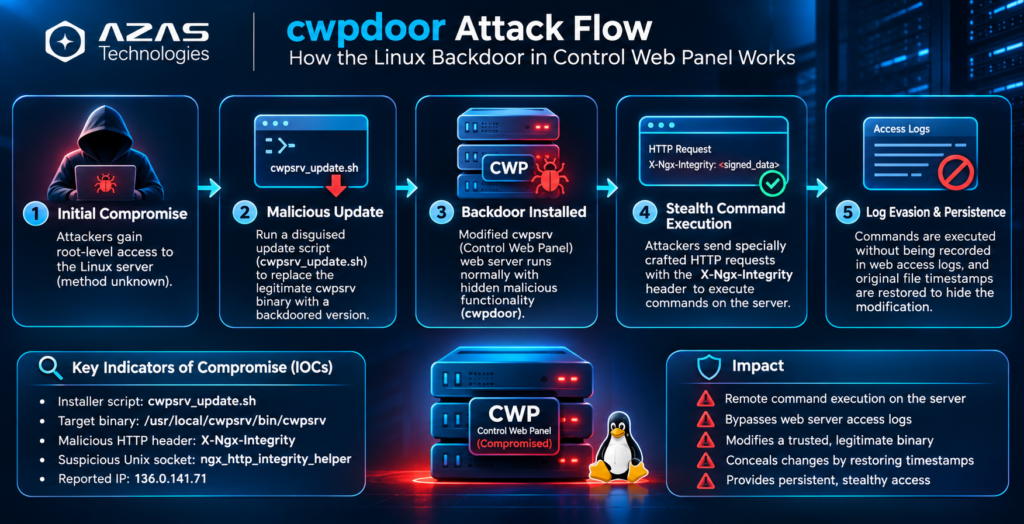
The attack relies on modifying a trusted web server component and using specially crafted requests to activate hidden malicious functionality.
Stage 1: Initial Server Compromise
Before installing cwpdoor, attackers must obtain root-level privileges on the targeted Linux server.
The precise initial compromise method has not been established.
Possible avenues that defenders should investigate include stolen administrator credentials, insecure remote access, vulnerable applications, or other privilege-escalation paths. These are general attack possibilities, not confirmed methods used in this campaign.
Stage 2: Malicious Update Installation
Researchers identified an installer script disguised as a routine web server version update.
The script, named cwpsrv_update.sh, is designed to replace the legitimate server executable with a maliciously modified version.
The observed installer specifically handles:
- cwpsrv version 1.15.10
- cwpsrv version 1.24.0
The attackers replace a trusted application component rather than installing an obviously separate malware executable.
Stage 3: Backdoor Activation Through HTTP Headers
After installation, the compromised web server continues handling ordinary requests.
The malicious functionality activates only when the server receives a request containing specially constructed headers beginning with:
X-Ngx-Integrity
These headers carry authentication information, including a timestamp and signature, that the backdoor validates before processing the attacker’s command.
This approach helps distinguish malicious control requests from normal web traffic.
Stage 4: Command Execution Without Access Logs
Once the malicious request passes the backdoor’s checks, the modified server can execute the supplied command.
A particularly dangerous characteristic is that these requests bypass normal web access logging.
As a result, administrators reviewing conventional web server logs may not find evidence of the command execution.
This creates a significant visibility gap for organizations that depend primarily on application logs for security monitoring.
Stage 5: Concealment and Persistence
The installer attempts to conceal the replacement of the legitimate server binary by restoring its original timestamps.
Common administrative commands such as ls and stat may therefore display familiar modification dates, even though the executable has been replaced.
Because the malicious functionality resides inside a trusted service binary, it can remain available as long as the modified component continues running.
Why This Backdoor Is Particularly Dangerous
1. Traditional Log Monitoring May Miss the Attack
Many organizations depend on web server access logs to detect suspicious requests, attempted exploitation, and unusual administrative activity.
cwpdoor deliberately avoids recording its triggering requests in these logs.
This demonstrates why security teams should correlate application logs with endpoint telemetry, network activity, and file integrity monitoring.
2. Trusted Software Becomes the Attack Platform
Instead of launching a separate malicious service, attackers modify an existing component that administrators expect to be present.
This technique can make malicious behavior harder to distinguish from legitimate application activity.
3. File Timestamps Cannot Be Trusted Alone
Restoring original file timestamps makes simple file modification checks unreliable.
Organizations should validate important executable files using cryptographic hashes and trusted software packages.
4. Root-Level Compromise Increases the Potential Impact
Because installing cwpdoor requires root privileges, an affected server must be treated as potentially fully compromised.
Depending on the server’s configuration and stored information, attackers may be able to access sensitive files, credentials, hosted applications, and other resources.
5. Antivirus Detection Alone Is Insufficient
Researchers reported that the modified binary initially went undetected by 63 antivirus engines.
This observation does not mean modern endpoint security tools cannot detect the malware, but it illustrates the limitations of relying exclusively on signature-based scanning.
How to Detect cwpdoor on Linux Servers
Security administrators operating Control Web Panel should perform targeted checks for the reported indicators.
Check 1: Identify suspicious Unix sockets
sudo ss -axp | grep integrityInvestigate any result containing:
ngx_http_integrity_helper
Researchers identified this socket as an indicator associated with the backdoor.
Check 2: Inspect cwpsrv processes
ps aux | grep cwpsrvReview the running processes for unexpected helper processes or suspicious execution behavior associated with cwpsrv.
Check 3: Search for malicious header strings
strings /usr/local/cwpsrv/bin/cwpsrv | grep X-Ngx-IntegrityThe presence of the reported header strings in the executable may indicate a modified server binary.
These checks are useful for initial triage, but a negative result does not conclusively establish that a server is clean. Attackers may modify or remove known indicators.
Indicators of Compromise (IOCs)
The following indicators were reported in the investigation.
| Indicator | Value |
|---|---|
| Malware name | cwpdoor |
| Installer script | cwpsrv_update.sh |
| Target executable | /usr/local/cwpsrv/bin/cwpsrv |
| Suspicious HTTP header prefix | X-Ngx-Integrity |
| Suspicious Unix socket | ngx_http_integrity_helper |
| Reported download server | 136.0.141[.]71 |
Reported MD5 hashes
Installer:
e505d4ffa21cf494a5dc2d7c8f4f1236
Backdoored cwpsrv 1.15.10:
965aea67fb40de1bab5169ada993349f
Backdoored cwpsrv 1.24.0:
d3f4e95113d49ab3991b45e457bda75b
Security teams should incorporate these indicators into their threat-hunting workflows while recognizing that hash-based detection identifies only known samples.
Recommended Security Measures for Organizations
Organizations using Linux hosting environments should adopt a layered approach to preventing and detecting similar threats.
1. Verify Server Software Integrity
Compare critical executable files against trusted, vendor-provided versions.
Implement file integrity monitoring for sensitive directories, including:
/usr/local/cwpsrv/bin/
Alert on unexpected changes to server executables, ownership, permissions, and cryptographic hashes.
2. Strengthen Privileged Access Security
Limit root access and enforce strong authentication controls for administrative accounts.
Use SSH key-based authentication, restrict administrative access to trusted networks, and review privileged activity regularly.
3. Deploy Endpoint Detection and Response
Deploy Linux-compatible EDR capabilities that can monitor suspicious process execution, unexpected child processes, file modifications, and unusual privileged activity.
Behavior-based detection can help identify threats that traditional antivirus signatures miss.
4. Centralize Security Monitoring
Forward operating system, authentication, and security telemetry to a centralized monitoring or SIEM platform.
Where appropriate, supplement local web server logs with network telemetry and reverse-proxy logging to improve visibility into suspicious HTTP requests.
5. Restrict Administrative Interfaces
Avoid exposing server administration panels directly to the public internet unless operationally necessary.
Use VPN access, network segmentation, firewall policies, and IP allowlisting to reduce exposure.
6. Maintain Secure Backups and Recovery Procedures
Maintain tested, protected backups of critical server configurations, applications, and business data.
For systems affected by root-level compromise, recovery from a verified clean image may provide greater assurance than simply replacing one suspicious executable.
What Should Organizations Do If cwpdoor Is Detected?
If evidence of cwpdoor is discovered, the affected server should be treated as a security incident.
Recommended actions include:
- Isolate the affected server using an approved incident response procedure.
- Preserve relevant forensic evidence, including suspicious binaries, process information, and security telemetry.
- Investigate how attackers obtained privileged access.
- Check for additional malware, unauthorized accounts, persistence mechanisms, and credential theft.
- Restore trusted software or rebuild the affected server from a verified clean image.
- Update the affected software through trusted vendor channels.
- Rotate potentially compromised administrator, service, and application credentials.
- Validate that malicious processes, sockets, and other indicators are no longer present.
- Continue enhanced monitoring before returning the system to normal operation.
Researchers also observed the Ebury malware in an archive containing cwpdoor. However, no confirmed operational relationship between the two malware families has been established.
What This Means for UAE Businesses
Organizations across the UAE increasingly depend on Linux servers to host websites, business applications, customer portals, databases, and cloud services.
The cwpdoor discovery demonstrates that infrastructure security requires more than routine patching and firewall protection.
A compromised administrative server can create risks involving unauthorized access, service disruption, sensitive information exposure, and potential movement into connected systems.
For UAE businesses, security priorities should include:
- Continuous monitoring of critical Linux infrastructure.
- Regular vulnerability assessments and penetration testing.
- Privileged account security and access reviews.
- Endpoint threat detection and incident response readiness.
- File integrity monitoring and centralized security visibility.
- Secure backup and disaster recovery planning.
How AZAS Technologies Can Help
At AZAS Technologies, we help organizations strengthen their cybersecurity posture through practical security assessments, monitoring, and infrastructure protection.
Our cybersecurity and IT security services can support organizations in identifying weaknesses and improving their ability to detect and respond to advanced threats.
Our capabilities include:
- Vulnerability Assessment and Penetration Testing (VAPT): Identify exploitable weaknesses in servers, applications, networks, and supporting infrastructure.
- Endpoint Security Solutions: Strengthen endpoint visibility and protection against malware, unauthorized execution, and suspicious behavior.
- Network and Infrastructure Monitoring: Improve operational visibility across servers, network devices, and critical IT services.
- Firewall and Network Security: Reduce unauthorized access and improve segmentation of critical infrastructure.
- Security Assessments and Hardening: Evaluate security configurations, privileged access controls, and infrastructure exposure.
By combining proactive assessments with layered security controls, organizations can improve resilience against threats that attempt to hide inside trusted infrastructure components.
Conclusion
The discovery of cwpdoor highlights an increasingly important threat to enterprise infrastructure: malicious functionality concealed inside legitimate server software.
By modifying the Control Web Panel web server, attackers can maintain a covert command execution capability while bypassing ordinary access logs and disguising changes to the underlying executable.
The key lesson is clear: a functioning server is not necessarily a secure server.
Organizations should move beyond basic log inspection and antivirus scanning toward continuous monitoring, trusted software integrity verification, privileged access protection, and coordinated incident response.
Secure Your Linux Infrastructure with AZAS Technologies
Is your organization confident that its Linux servers and critical infrastructure are protected against hidden backdoors and unauthorized access?
Contact AZAS Technologies to discuss vulnerability assessments, endpoint security, network protection, and infrastructure security solutions.
Website: https://azastechnologies.com
Contact: https://azastechnologies.com/contact-us/
Sources and References
- The Hacker News — Hackers Hide Linux Backdoor in Control Web Panel Server to Execute Commands Without Logs, November 6, 2026.
https://thehackernews.com/2026/11/hackers-hide-linux-backdoor-in-control.html - QiAnXin XLab — Original cwpdoor technical investigation, linked from The Hacker News report.
This article is an independent cybersecurity analysis prepared for AZAS Technologies using publicly reported threat intelligence. It is intended for security awareness and defensive purposes.