How intelligent voice automation is transforming customer engagement in the UAE and beyond
Introduction
In today’s interconnected business environment, effective communication is essential for delivering exceptional customer experiences. However, language differences remain a significant challenge for organizations serving diverse customer populations.
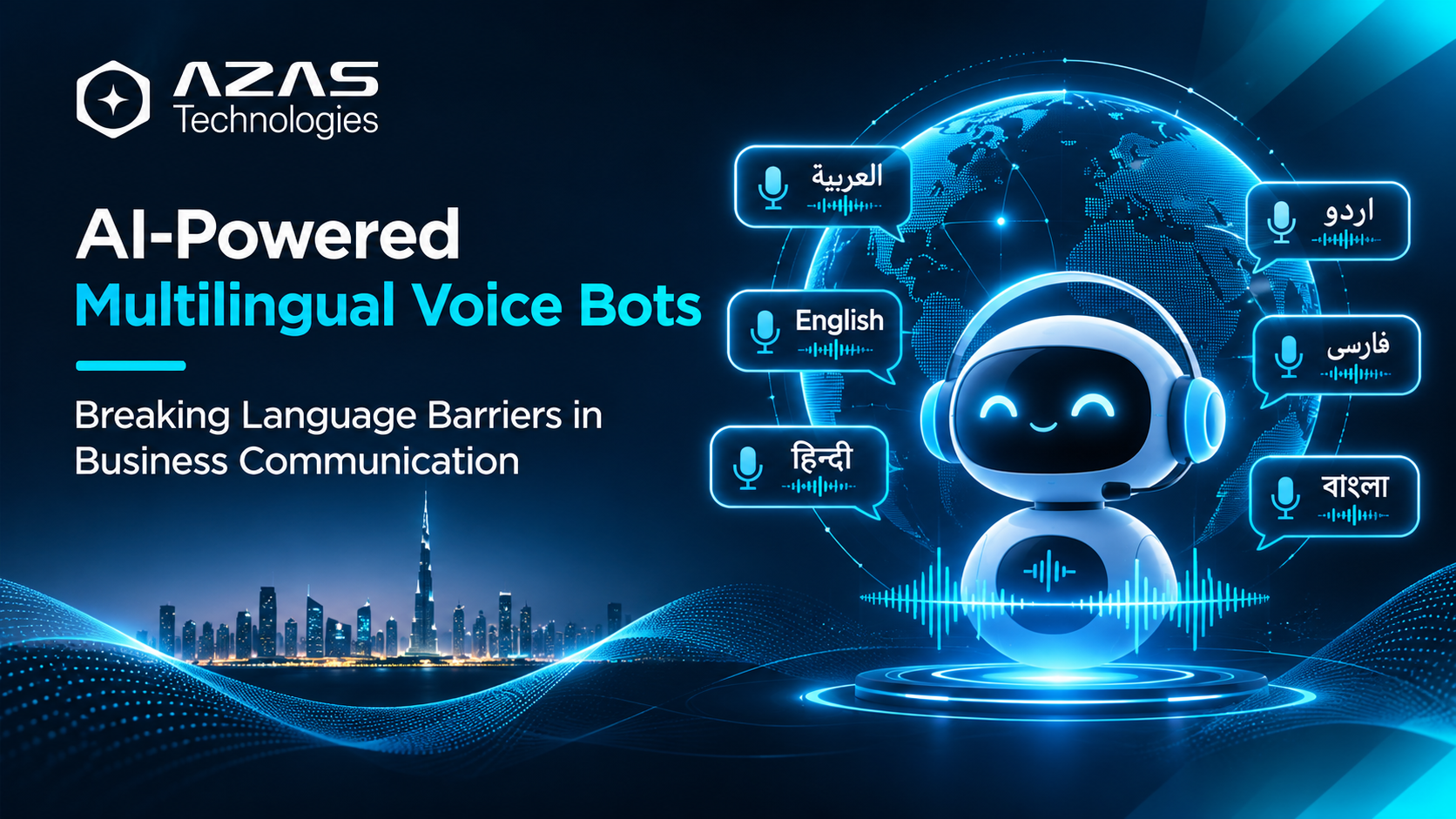
In multicultural markets such as the United Arab Emirates (UAE), businesses regularly interact with customers who speak Arabic, English, Hindi, Urdu, and many other languages. Providing consistent, high-quality customer service across these languages can be operationally challenging and expensive.
AI-powered multilingual voice bots are transforming how businesses communicate with customers, enabling intelligent, automated, and personalized conversations in multiple languages.
By combining Artificial Intelligence (AI), Natural Language Processing (NLP), speech recognition, and conversational automation, these solutions help organizations overcome language barriers while improving service efficiency and customer satisfaction.
What Are AI-Powered Multilingual Voice Bots?
AI-powered multilingual voice bots are intelligent conversational systems designed to interact with customers through natural spoken language.
Unlike traditional Interactive Voice Response (IVR) systems that require customers to navigate predefined menus, AI voice bots can understand spoken requests, identify customer intent, and respond conversationally.
Advanced multilingual voice bots can support multiple languages within a single communication platform, allowing businesses to serve diverse audiences without maintaining separate contact center operations for every language.
Key Capabilities
- Multilingual communication: Support conversations in Arabic, English, Hindi, Urdu, and other configured languages.
- Automatic language detection: Identify a customer’s preferred language from speech when supported by the platform.
- Natural Language Understanding: Interpret customer questions and requests.
- Intelligent call routing: Transfer conversations to appropriate departments or human agents.
- 24/7 automated assistance: Handle common inquiries outside normal business hours.
- CRM integration: Retrieve relevant customer information and update service records.
- Conversational AI: Deliver contextual responses rather than rigid, menu-driven interactions.
These capabilities enable organizations to deliver faster and more accessible customer experiences.
Why Multilingual AI Voice Bots Matter in the UAE
The UAE is home to a diverse international population and serves as a major hub for tourism, healthcare, financial services, retail, logistics, and hospitality.
Businesses operating in this environment frequently need to communicate with customers from different linguistic and cultural backgrounds.
Traditional customer service models often depend on recruiting multilingual employees or transferring calls between language-specific teams.
AI-powered multilingual voice bots provide an alternative by automating routine customer interactions across supported languages.
Business Benefits
1. Improved Customer Experience
Customers can communicate in their preferred language, reducing misunderstandings and making interactions more convenient.
2. Reduced Operational Costs
Automating repetitive inquiries reduces the workload on customer service teams and allows human agents to focus on complex issues.
3. Round-the-Clock Availability
AI voice bots can respond to customer requests at any time, including weekends, holidays, and outside business hours.
4. Faster Response Times
Voice automation can handle multiple simultaneous interactions, reducing queues during peak periods.
5. Consistent Service Delivery
Organizations can standardize responses, workflows, and customer service procedures across supported languages.
6. Scalable Communication Infrastructure
Businesses can expand automated customer engagement without increasing staffing proportionally for every additional language.
How AI-Powered Multilingual Voice Bots Work
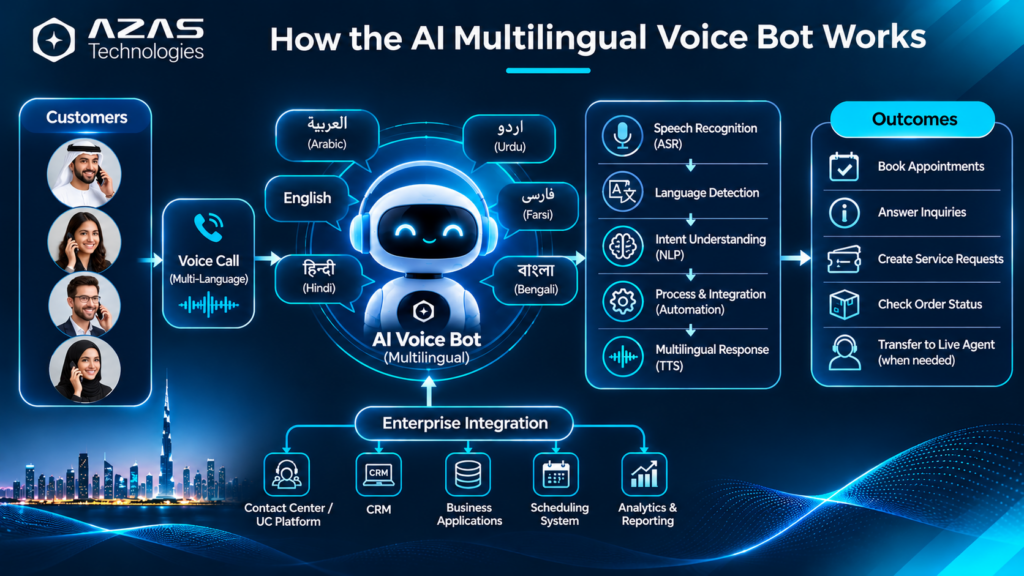
Modern AI voice bots combine several technologies to deliver intelligent customer conversations.
Step 1: Customer Initiates a Conversation
A customer calls a business using a traditional telephone number, contact center line, or supported voice communication channel.
Step 2: Speech Recognition and Language Identification
Automatic Speech Recognition (ASR) converts spoken audio into text. Language identification determines the customer’s language where the platform supports this capability.
Step 3: Natural Language Understanding
The conversational AI engine analyzes the customer’s request to identify intent, relevant information, and conversational context.
Step 4: Business System Integration
The voice bot connects to authorized systems such as CRM platforms, appointment scheduling applications, ticketing systems, or business databases to retrieve information or complete tasks.
Step 5: Intelligent Response Generation
The system generates an appropriate response using approved business knowledge, workflow rules, and AI-based conversational capabilities.
Step 6: Multilingual Voice Response
Text-to-Speech (TTS) technology converts the response into natural-sounding speech in the customer’s selected language.
Step 7: Human Agent Escalation
When a request is complex, sensitive, or cannot be resolved automatically, the conversation can be transferred to a human agent, ideally with relevant context preserved.
This workflow enables businesses to combine automated efficiency with human assistance when necessary.
Industry Applications of Multilingual AI Voice Bots
Hospitality and Tourism
Hotels and resorts can use multilingual voice bots to manage room inquiries, reservation requests, service information, and guest assistance.
For example, an international guest may inquire about hotel facilities in Arabic, while another guest requests booking information in English or Hindi.
Healthcare
Hospitals, clinics, and medical centers can automate appointment scheduling, appointment reminders, visiting-hour inquiries, and general service information.
Multilingual support helps patients navigate administrative services more easily. Sensitive medical decisions and urgent clinical requests should remain subject to appropriate human oversight.
Banking and Financial Services
Financial institutions can automate general product inquiries, branch information, service requests, and selected account-related workflows after appropriate authentication.
Secure identity verification and regulatory compliance remain essential for financial transactions.
Retail and E-Commerce
Retail businesses can use AI voice bots for order-status inquiries, delivery updates, return procedures, product availability, and customer support.
Real Estate
Real estate companies can automate property inquiries, schedule viewing appointments, qualify leads, and provide general project information in multiple languages.
Government and Public Services
Public service organizations can improve accessibility by providing multilingual assistance for general inquiries, service information, and appointment scheduling.
AI Voice Bots vs Traditional IVR Systems
Traditional IVR solutions have served businesses for decades, but conversational AI introduces more flexible interaction models.
| Feature | Traditional IVR | AI Multilingual Voice Bot |
|---|---|---|
| Customer interaction | Menu-based navigation | Natural spoken conversations |
| Language support | Preconfigured language menus | Multiple languages with possible automatic detection |
| Intent recognition | Limited | AI-powered understanding |
| Personalization | Primarily rule-based | Contextual, subject to available data |
| CRM integration | Possible | Possible with conversational workflows |
| Complex inquiries | Typically transferred | Can attempt resolution or escalate |
| Availability | 24/7 where configured | 24/7 where configured |
Rather than replacing every IVR system, AI voice bots can enhance existing telephony infrastructure and introduce conversational capabilities where they provide measurable value.
Integrating Multilingual Voice Bots with Unified Communications
The true potential of AI-powered voice bots becomes apparent when they are integrated with a Unified Communications (UC) and contact center environment.
Organizations can connect conversational AI with:
- Enterprise telephony and SIP infrastructure
- Contact center and call-routing platforms
- CRM and customer service applications
- Helpdesk and ticketing systems
- Appointment scheduling solutions
- Business databases and approved knowledge bases
- Analytics and reporting dashboards
- Supported digital communication channels
Such integration creates a more connected customer engagement environment.
For example, a customer contacting a hotel could ask about a reservation in Arabic. The voice bot could identify the request, access the authorized reservation system, provide relevant details, and transfer the conversation to an employee when necessary.
Security and Data Privacy Considerations
Deploying AI-powered voice bots requires careful consideration of cybersecurity, privacy, and governance.
Businesses should implement appropriate controls, including:
- Encryption of communications and sensitive data
- Role-based access controls
- Secure API integrations
- Customer authentication for sensitive transactions
- Data retention and deletion policies
- Audit logging and monitoring
- Protection against unauthorized access
- Compliance with applicable UAE data protection requirements
- Appropriate customer notices and consent where required
AI responses should also be grounded in trusted business information, with safeguards against inaccurate answers and unauthorized actions.
Security should be incorporated throughout solution design, deployment, and ongoing operations.
Best Practices for Implementing Multilingual AI Voice Bots
Successful implementation requires more than selecting an AI platform.
Identify high-volume use cases: Begin with repetitive inquiries such as appointment scheduling, business hours, booking information, and service requests.
Prioritize customer languages: Select languages based on actual customer demographics and call volumes.
Test regional language variations: Evaluate pronunciation, dialects, accents, and mixed-language conversations, particularly for Arabic and South Asian languages.
Integrate securely: Connect the voice bot with authorized enterprise systems using secure APIs and appropriate permissions.
Provide human escalation: Ensure customers can reach an employee when automation is insufficient.
Monitor performance: Track containment rates, resolution rates, customer satisfaction, response accuracy, and escalation frequency.
Continuously improve: Use approved analytics and customer feedback to refine conversational workflows and language performance.
The Future of Multilingual AI Voice Automation
Advances in speech recognition, generative AI, and conversational intelligence are creating new opportunities for business communication.
Emerging capabilities include more natural voice interactions, improved recognition of regional accents, context-aware conversations, real-time multilingual assistance, and deeper integration with enterprise applications.
As these technologies mature, organizations will be able to automate increasingly sophisticated workflows while maintaining appropriate security, governance, and human oversight.
For businesses operating in the UAE, multilingual AI voice automation represents an opportunity to make customer communication more accessible, responsive, and scalable.
How AZAS Technologies Can Help
At AZAS Technologies, we help organizations explore intelligent communication solutions that combine AI-driven automation, Unified Communications, and enterprise technology integration.
Our focus is on helping businesses modernize customer engagement through solutions such as:
- AI-powered voice bots and conversational assistants
- Multilingual customer communication workflows
- Unified Communications solutions
- Contact center automation
- CRM and business application integration
- Intelligent call routing and workflow automation
- Secure enterprise communication architectures
Whether your organization is looking to automate routine customer inquiries, enhance multilingual customer support, or modernize its communication infrastructure, AZAS Technologies can help evaluate and design a solution aligned with your operational requirements.
Conclusion
Language should never be a barrier to effective business communication.
AI-powered multilingual voice bots enable organizations to engage customers in their preferred languages, automate repetitive tasks, and deliver more responsive customer experiences.
For businesses in the UAE, combining multilingual conversational AI with Unified Communications offers a practical path toward more efficient, accessible, and scalable customer engagement.
Transform Your Business Communication with AI
Discover how AZAS Technologies can help your organization explore AI-powered multilingual voice automation and intelligent Unified Communications.
Contact AZAS Technologies: https://azastechnologies.com/contact-us/
Innovating for a Secure Digital Future.