
A single compromised employee laptop may have opened the door to one of the largest cryptocurrency thefts in history. The Binance security incident highlights how attackers can exploit enterprise infrastructure, privileged access, and weaknesses in transaction authorization systems to cause devastating financial losses.
Introduction: A $6.3 Billion Wake-Up Call for Cybersecurity
On October 29, 2026, Binance, one of the world’s largest cryptocurrency exchanges, experienced a major cybersecurity incident involving approximately $6.3 billion in digital assets.
According to Binance’s preliminary investigation, the attack may have originated from a compromised laptop belonging to a DevOps engineer. However, subsequent investigations uncovered additional points of compromise, indicating a coordinated, multi-stage attack rather than an isolated endpoint security failure.
Binance reported that attackers accessed internal infrastructure and submitted unauthorized withdrawal transactions. Importantly, the company stated that it had found no evidence that wallet private keys had been leaked.
The incident demonstrates a critical cybersecurity reality: organizations can suffer catastrophic breaches even when their most sensitive cryptographic secrets remain protected.
For businesses across the UAE, the attack offers important lessons about endpoint security, privileged access management, Zero Trust architecture, and continuous threat monitoring.
What Happened During the Binance Cyberattack?
Based on official statements released on October 30, 2026, Binance identified several important findings:
- Approximately $6.3 billion in cryptocurrency assets were stolen from hot wallets.
- The initial compromise may have involved an employee’s laptop.
- Attackers accessed a service container and submitted unauthorized withdrawal transactions.
- Investigators discovered additional points of compromise beyond the initial laptop.
- Binance reported no evidence of leaked wallet private keys.
- Approximately $3 billion in affected assets had been frozen on-chain at the time of the update.
- Binance committed to covering customer losses through its Secure Asset Fund for Users (SAFU) and corporate funds.
The investigation remained ongoing, and the complete technical attack chain had not yet been publicly established.
How Could a Compromised Laptop Lead to a Multibillion-Dollar Breach?
The following infographic illustrates the reported stages of the Binance security incident, from the initial endpoint compromise to unauthorized transactions and incident response. It highlights how weaknesses across multiple security layers can potentially enable a sophisticated cyberattack.
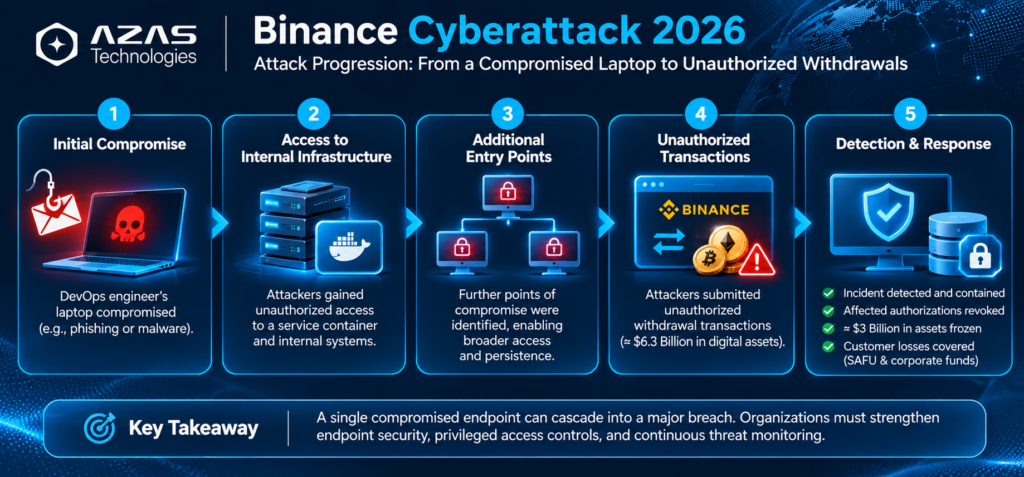
An employee laptop is often considered a relatively small component of enterprise infrastructure. However, for developers, system administrators, and DevOps engineers, these devices may provide access to sensitive operational environments.
A compromised workstation can become a powerful entry point into an organization’s broader infrastructure.
1. Initial Endpoint Compromise
The first stage reportedly involved a compromised employee laptop.
The precise initial infection method had not been publicly confirmed. In enterprise environments, common techniques include phishing, malicious software, stolen credentials, and exploitation of endpoint vulnerabilities.
Once attackers gain access to a workstation, they may attempt to obtain authentication tokens, discover internal systems, or exploit existing administrative sessions.
Security lesson: Endpoint protection must extend beyond traditional antivirus software. Organizations should deploy advanced Endpoint Detection and Response (EDR) solutions capable of detecting suspicious behavior, credential misuse, and abnormal processes.
2. Access to Internal Infrastructure
Binance indicated that the compromised environment enabled unauthorized access to a service container.
Containers are widely used in modern applications, DevOps pipelines, and cloud-native infrastructure.
If container environments have excessive permissions, weak access controls, or insufficient isolation, attackers may be able to interact with sensitive services.
Security lesson: Organizations must secure container workloads, enforce least-privilege permissions, protect secrets, and monitor access to critical infrastructure.
3. Multiple Points of Compromise
Binance subsequently identified additional breach points, demonstrating that the incident was more complex than a single compromised workstation.
This is an important characteristic of sophisticated cyberattacks.
Attackers may establish multiple access paths to maintain control, move between systems, or bypass security restrictions.
The precise methods used in the Binance incident remain subject to investigation.
Security lesson: Network segmentation, Zero Trust access controls, and continuous monitoring can help prevent an initial compromise from spreading across enterprise systems.
4. Unauthorized Financial Transactions
The attackers were able to initiate unauthorized cryptocurrency withdrawals.
Although Binance reported no evidence of private-key leakage, the incident illustrates the importance of protecting the systems responsible for authorizing sensitive transactions.
Protecting encryption keys alone is insufficient if attackers can manipulate the infrastructure or workflows that request legitimate signing operations.
Security lesson: Critical business transactions should require independent authorization controls, behavioral validation, and separation of duties.
5. Detection, Containment, and Incident Response
Following detection, Binance implemented containment measures, revoked affected authorizations, suspended withdrawals temporarily, and coordinated with blockchain intelligence firms and law enforcement.
The company also worked with industry partners to freeze affected assets.
Security lesson: An effective incident response plan should include rapid containment, credential and token revocation, forensic investigation, communication procedures, and recovery validation.
Why the Absence of Private-Key Leakage Matters
One of the most significant findings was Binance’s statement that investigators had not discovered evidence of compromised wallet private keys.
This distinction matters because a private-key theft and an attack against transaction authorization infrastructure represent different security failures.
An attacker may not need direct access to a cryptographic key if they can compromise a trusted application, workflow, or service that is authorized to request transactions.
The same principle applies beyond cryptocurrency.
For example, attackers targeting enterprise infrastructure may exploit legitimate administrative tools, trusted service accounts, automated workflows, or application integrations.
The broader lesson is that trusted systems and authorization processes must be protected just as carefully as sensitive credentials and encryption keys.
Five Cybersecurity Lessons for UAE Businesses
The Binance incident provides valuable lessons for organizations operating in financial services, healthcare, government, retail, logistics, and other critical sectors.
1. Implement Advanced Endpoint Security
Deploy EDR or Extended Detection and Response (XDR) solutions across employee laptops, administrative workstations, and servers.
Prioritize high-risk devices used by administrators, developers, and IT operations personnel.
2. Adopt Zero Trust Security Principles
Never assume that a user, device, or service is trustworthy simply because it operates inside the corporate network.
Enforce strong authentication, device compliance checks, least-privilege access, and continuous verification.
3. Secure Privileged Accounts and DevOps Infrastructure
Implement Privileged Access Management (PAM), dedicated administrative workstations, secure secrets management, and strict access controls for production environments.
Audit CI/CD pipelines, container orchestration platforms, and service-account permissions.
4. Strengthen Continuous Security Monitoring
Centralize endpoint, identity, network, cloud, and application security telemetry.
Use security monitoring and threat detection platforms to identify unusual authentication activity, unauthorized configuration changes, suspicious lateral movement, and abnormal transactions.
5. Conduct Regular Security Assessments
Perform Vulnerability Assessment and Penetration Testing (VAPT), Active Directory security reviews, cloud security assessments, and incident response exercises.
These activities help organizations identify exploitable weaknesses before attackers can combine them into a larger attack chain.
How AZAS Technologies Helps Organizations Strengthen Cybersecurity
At AZAS Technologies, we help businesses across the UAE strengthen their cybersecurity posture through proactive security assessments, endpoint protection, network security, and continuous monitoring.
Our cybersecurity services include:
- Endpoint Security and EDR/XDR: Protection against advanced malware, suspicious endpoint activity, and emerging threats.
- Vulnerability Assessment and Penetration Testing: Identification and validation of security weaknesses across networks, applications, and infrastructure.
- Network Security Solutions: Next-generation firewalls, network segmentation, and secure access controls.
- Security Configuration Assessments: Evaluation of critical infrastructure, security policies, and privileged access configurations.
- Network Monitoring: Infrastructure availability, performance, and operational visibility using solutions such as Paessler PRTG.
By combining preventive security controls with continuous monitoring and regular assessments, organizations can reduce the likelihood and impact of sophisticated cyberattacks.
Final Thoughts: A Compromised Endpoint Can Become an Enterprise-Wide Threat
The October 2026 Binance incident is a reminder that cybersecurity is only as effective as the controls protecting the entire technology environment.
Even where sensitive encryption keys remain protected, attackers may exploit weaknesses in endpoints, service infrastructure, privileged access, and transaction authorization processes.
For UAE businesses undergoing digital transformation, cybersecurity must be treated as an ongoing operational priority rather than a one-time technology investment.
A single compromised device should never be enough to compromise an organization’s most critical assets.
Strengthen Your Cybersecurity with AZAS Technologies
Is your organization prepared to detect and contain an attack that begins with a compromised employee laptop?
AZAS Technologies helps UAE businesses identify vulnerabilities, strengthen endpoint security, assess critical infrastructure, and improve network visibility.
Contact AZAS Technologies today to discuss your cybersecurity requirements and protect your business against evolving cyber threats.
Website: https://azastechnologies.com
Contact: https://azastechnologies.com/contact-us/
Frequently Asked Questions
1. What caused the Binance cyberattack in October 2026?
Binance’s preliminary investigation suggested that the incident may have started with a compromised DevOps engineer’s laptop. Investigators subsequently identified additional points of compromise. The full technical cause remains under investigation.
2. Were Binance wallet private keys stolen?
Binance stated on October 30, 2026, that it had found no evidence of leaked wallet private keys. This finding was preliminary and subject to further investigation.
3. How much cryptocurrency was affected?
Binance reported approximately $6.3 billion in stolen digital assets, with about $3 billion frozen on-chain as of its October 30 update.
4. How can businesses protect themselves from similar attacks?
Organizations should implement EDR/XDR, Zero Trust access controls, privileged access management, network segmentation, continuous monitoring, and regular penetration testing.
5. Why are DevOps laptops attractive targets for cybercriminals?
DevOps engineers may have access to production systems, deployment pipelines, cloud infrastructure, and administrative tools. Compromising these endpoints can potentially provide attackers with valuable access to enterprise environments.
References and Further Reading
- Binance News — October 30, 2026 security incident update
- Binance Official Security Incident Update #2 — October 30, 2026
- BleepingComputer — Binance links $6.3 billion crypto theft to compromised DevOps laptop
- Reuters — Gone in 20 minutes: How the biggest heist in crypto history unfolded
Editorial note: The incident details reflect publicly available information as of November 2, 2026. The investigation is ongoing. Defensive recommendations and generalized attack scenarios are AZAS Technologies’ analysis and should not be interpreted as confirmed forensic findings.