
Critical Linux Kernel Vulnerability CVE-2026-98432: AI-Assisted Exploitation Threatens Ubuntu Servers
A long-standing TCP memory-safety flaw highlights the risks of delayed patching and AI-assisted exploit development.
Introduction
A serious Linux kernel vulnerability, tracked as CVE-2026-98432, has prompted renewed attention to kernel patch management. Research described in October 2026 reported a remote exploitation chain against certain Linux configurations, developed with assistance from an experimental AI model.
For organizations operating Linux web servers, cloud workloads, database hosts and other critical infrastructure, the case underscores the importance of knowing which kernel is actually running—not simply whether package updates have completed.
Vulnerability at a Glance
The reported issue involves the lifetime of stored IPv4 options while Linux processes incoming TCP connection requests. Under specific timing conditions, one CPU may continue using memory that another CPU has already released.
How the Linux TCP Vulnerability Works
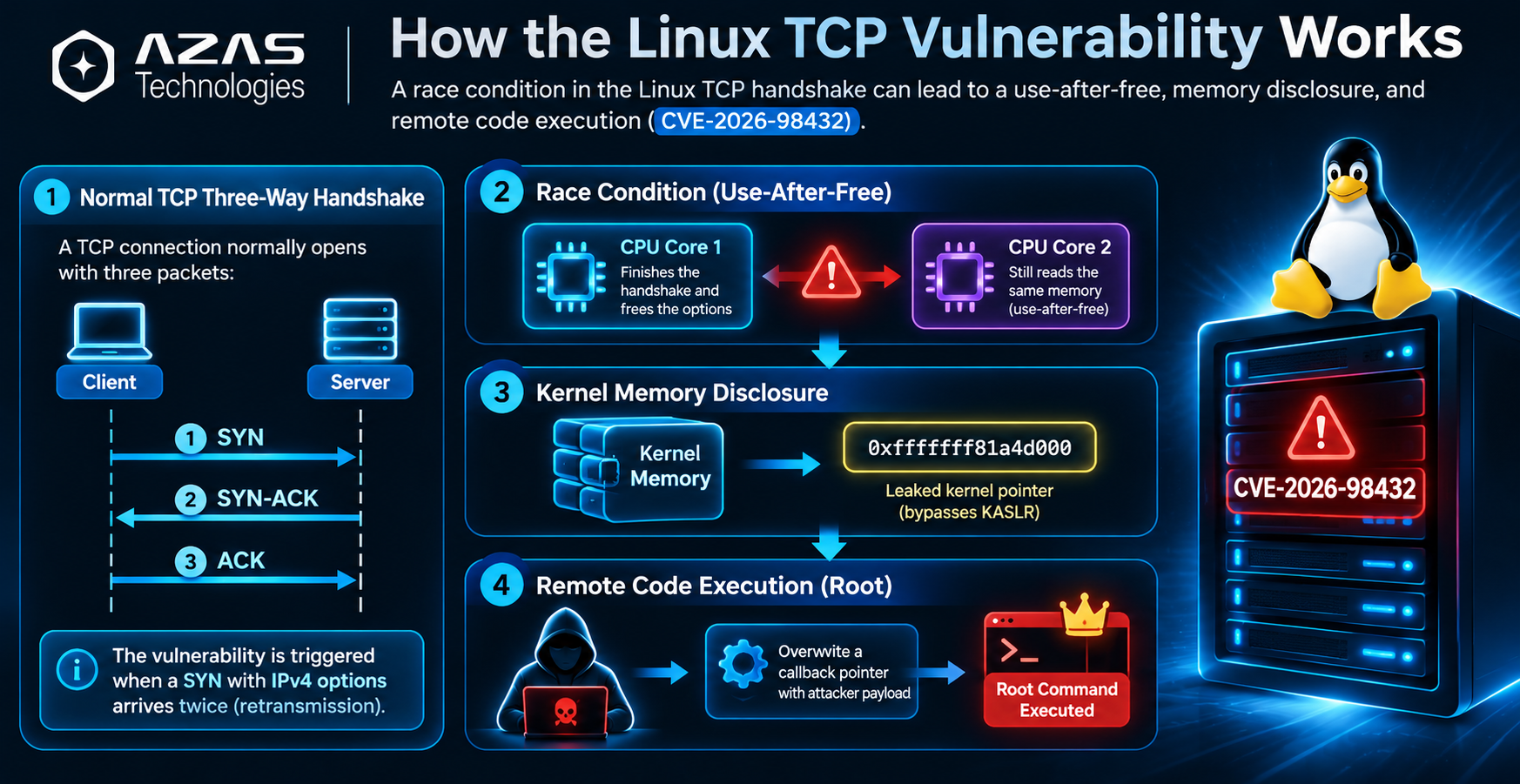
Figure 1: CVE-2026-98432 Linux TCP vulnerability attack flow, illustrating the TCP handshake, race condition, kernel memory disclosure, and potential root-level code execution.
1. TCP handshake and retransmissions
A standard TCP connection starts with SYN, SYN-ACK and ACK packets. Clients may retransmit SYN packets if responses are delayed. The kernel processes these packets while managing request-specific data, including IPv4 options.
2. Race condition and use-after-free
Two processor cores can handle related connection activity at overlapping times. If stored options are released before all readers have finished, a reader may access freed memory.
3. Information disclosure
In the reported research, carefully timed attempts could expose kernel memory information. A leaked pointer can undermine kernel address-space randomization (KASLR), which normally makes exploitation more difficult.
4. Potential command execution
The researchers described a subsequent exploitation stage leading to execution of an attacker-selected command with root privileges in a controlled environment. The published demonstration required precise timing and memory manipulation; it should not be interpreted as guaranteed exploitation of every Linux server.
Why AI-Assisted Exploit Development Matters
Anthropic's Frontier Red Team reported using an experimental AI model in the research process. Its account described approximately 48 minutes to obtain a kernel pointer and five additional minutes to reach command execution in testing.
The broader security concern is a potentially shorter interval between vulnerability discovery and sophisticated exploitation. Security teams should therefore shorten their own assessment, testing and remediation cycles while still validating vendor guidance.
Linux Distribution Patch Status
The following summarizes the historical status described in reporting dated November 3, 2026. It is not a live patch-status check. Confirm the current status and exact fixed package versions with each vendor before publishing or deploying changes.
| Distribution | Reported status on Nov. 3 |
|---|---|
| Ubuntu 22.04 LTS | Fixed kernel undergoing qualification testing |
| Ubuntu 24.04 LTS | Fixed kernel undergoing qualification testing |
| Ubuntu 26.04 LTS | Fixed kernel undergoing qualification testing |
| Debian | Fixed packages reportedly released |
| Red Hat Enterprise Linux 8/9/10 | Security updates reportedly released |
| SUSE Linux | Updates for selected releases; others in progress |
How to Check an Ubuntu Server
Identify the currently running kernel:
uname -rList installed kernel image packages:
dpkg -l 'linux-image*' | grep ^iiCheck whether MPTCP is enabled and inspect MPTCP listeners:
sysctl net.mptcp.enabled
sudo ss -lnMp
These commands support an initial assessment, but they do not by themselves prove that a server is patched. Compare the active kernel version and package build against the distribution's official advisory.
Recommended Mitigation and Remediation
- Install vendor-supported fixes: Prioritize affected, externally reachable systems and follow the distribution's security guidance.
- Reboot and verify: Where required, restart after a kernel update and run
uname -rto verify the active version. - Review exposed services: Identify public-facing TCP listeners, including MPTCP-enabled applications.
- Consider temporary filtering: If the vendor recommends filtering incoming IPv4 TCP packets with IP options, test thoroughly for compatibility before production rollout. Such controls are not a permanent fix.
- Monitor for anomalies: Correlate unusual TCP connection patterns with firewall, EDR and server logs.
- Maintain rollback readiness: Test updates and retain a documented recovery procedure for critical systems.
Business Impact
A successful kernel-level compromise may expose sensitive information, disrupt applications, permit unauthorized administrative activity and provide a foothold for further intrusion. Internet-facing services, shared hosting platforms and business-critical Linux systems deserve special attention.
How AZAS Technologies Can Help
AZAS Technologies supports organizations with vulnerability assessment and penetration testing (VAPT), infrastructure security reviews, server hardening, network monitoring and remediation planning. Our approach helps teams identify exposed assets, prioritize business-critical risks and validate corrective actions.
Conclusion
CVE-2026-98432 illustrates how long-standing kernel defects can become urgent operational risks. AI-assisted vulnerability research adds further pressure to the patch-management timeline. Organizations should verify affected assets, follow authoritative vendor advisories and confirm that fixed kernels are actively running.
Protect Your Linux Infrastructure
Contact AZAS Technologies for vulnerability assessments, cybersecurity reviews and remediation support.
Contact Our Security TeamSources and Further Reading
Editorial note: Distribution patch statuses and vulnerability ratings are time-sensitive. Recheck vendor advisories before publication.