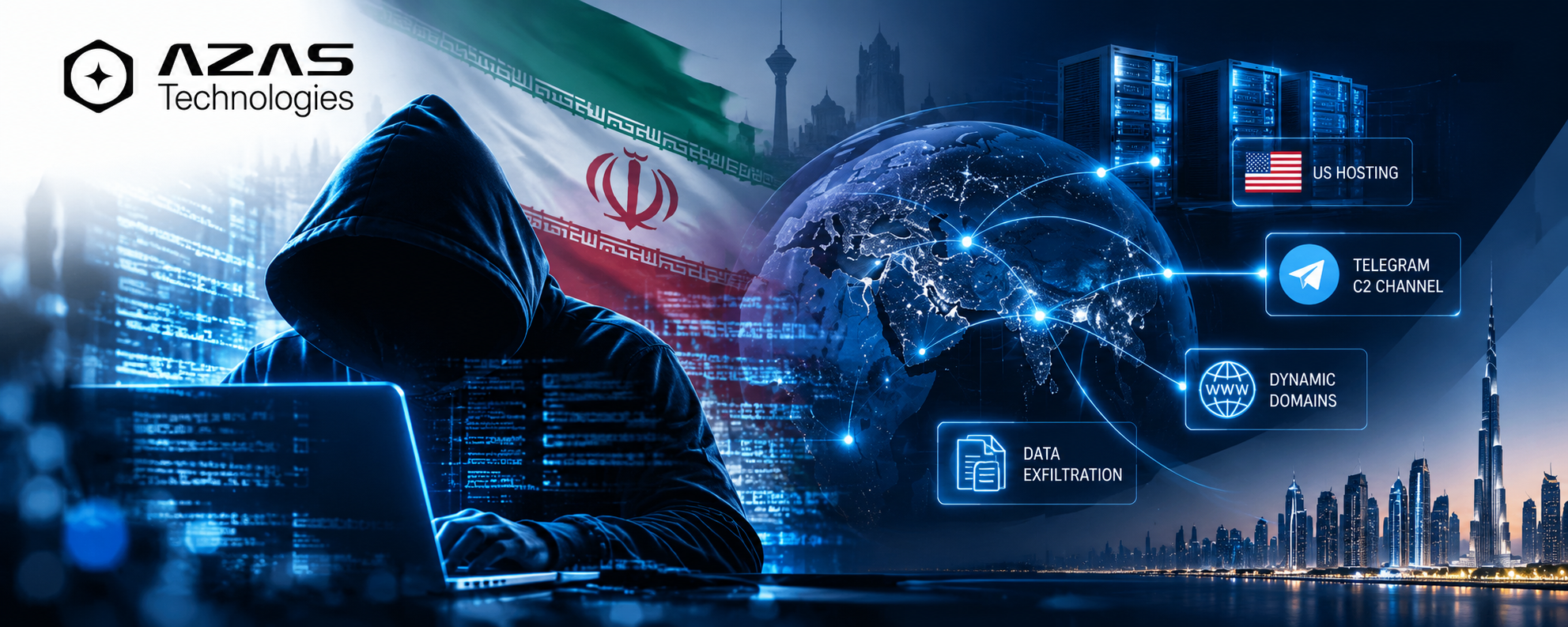
How a long-running cyber espionage operation is using Telegram, shared hosting, and advanced malware to evade traditional security defenses.
Introduction: A Cyber Threat Hiding in Plain Sight
Cyber espionage is becoming increasingly sophisticated, with advanced persistent threat (APT) groups continuously adapting their techniques to evade detection and maintain unauthorized access to targeted networks.
One such group, Prince of Persia, an Iranian state-linked cyber espionage actor also known for its Infy malware operations, has resurfaced with a significantly evolved command-and-control (C2) infrastructure.
According to cybersecurity research published by Semperis on October 22, 2026, the threat group has changed its infrastructure strategy, moved critical attack servers to shared hosting environments in the United States, and continued developing malware capable of communicating through legitimate online services.
The findings demonstrate an important cybersecurity challenge: malicious activity can hide within trusted infrastructure and ordinary-looking network traffic.
For organizations across the UAE and Middle East, these developments highlight the importance of advanced threat detection, endpoint protection, continuous monitoring, and proactive vulnerability management.
Who Is the Prince of Persia Threat Group?
Prince of Persia is a long-running advanced persistent threat group associated by security researchers with Iranian state-sponsored cyber espionage.
Its activities date back to approximately 2010, with public reporting emerging in 2016 following investigations by Palo Alto Networks Unit 42.
Unlike financially motivated cybercriminal groups that primarily deploy ransomware or steal payment information, Prince of Persia has historically focused on intelligence gathering and surveillance.
Its reported targets include:
- Government and diplomatic organizations
- Political activists and dissidents
- Media and journalism organizations
- Public-sector institutions
- Selected private-sector organizations
- Individuals and entities connected to geopolitical interests
The group has demonstrated considerable operational persistence, evolving its malware and communication infrastructure in response to cybersecurity research and defensive countermeasures.
What Did Researchers Discover in 2026?
Recent Semperis research revealed several significant developments in the group’s operations.
1. A Return After Months of Reduced Visibility
Following security research published in February 2026, Prince of Persia modified its command-and-control infrastructure and entered a prolonged period of operational inactivity.
Researchers subsequently identified renewed activity beginning in May 2026.
This demonstrated the group’s ability to rebuild its infrastructure and resume operations after exposure.
2. Command-and-Control Servers Hosted in the United States
One of the most notable discoveries was the group’s use of US-based hosting infrastructure for a Tornado second-stage C2 server.
Instead of relying exclusively on its earlier hosting arrangements, the attackers moved to shared hosting environments where malicious services could coexist with legitimate websites.
This approach can complicate detection because security teams cannot safely assume that infrastructure hosted in a reputable region or by a legitimate provider is trustworthy.
3. Increased Use of Legitimate Internet Services
The group’s latest malware ecosystem incorporates communication mechanisms involving:
- HTTPS-based command-and-control traffic
- Telegram APIs
- Domain Generation Algorithms (DGAs)
- Blockchain-related mechanisms for updating C2 routing information
These capabilities help attackers maintain communication with infected devices even when individual domains or servers are discovered and blocked.
4. Continued Data Exfiltration
Researchers observed renewed data theft following the group’s infrastructure changes.
In one documented case, the Tonnerre malware reportedly exfiltrated more than 1,800 files from a victim during the first week of observed activity.
This illustrates how a successful cyber espionage intrusion can lead to substantial information exposure without necessarily causing the visible disruption commonly associated with ransomware.
Understanding the Prince of Persia Malware Ecosystem
The group uses several malware families that support different stages of compromise, persistence, surveillance, and data theft.
Infy: The Original Espionage Malware
Infy is one of the earliest malware families associated with Prince of Persia.
Its capabilities include remote system access, command execution, and information collection.
The malware established the foundation for the group’s long-term espionage operations.
Foudre: Initial Compromise and Reconnaissance
Foudre acts as an initial-stage malware component.
It can perform system reconnaissance, establish persistence, collect credentials, log keystrokes, and identify whether an infected device is valuable enough for further exploitation.
This enables attackers to selectively deploy more advanced tools against high-value targets.
Tonnerre: Advanced Surveillance and Data Theft
Tonnerre provides additional espionage capabilities.
Depending on the variant, these include:
- Capturing screenshots
- Recording audio
- Extracting sensitive documents
- Collecting credentials and browser information
- Communicating through HTTP and Telegram-based channels
Its functionality makes it particularly dangerous in environments containing confidential business information or sensitive operational data.
Tornado: The Next Generation of Stealth Malware
Tornado represents a newer stage in the group’s malware evolution.
Research has documented its use of HTTPS, Telegram-based communications, and domain generation techniques to maintain access to its command infrastructure.
Some reported variants also use blockchain-derived information to update command-and-control routing without requiring a conventional malware update.
These techniques increase operational resilience and make detection more challenging for security systems that depend heavily on static indicators.
How Does a Prince of Persia Cyberattack Work?
Although the exact sequence varies by campaign, the group’s documented capabilities support the following representative attack scenario.
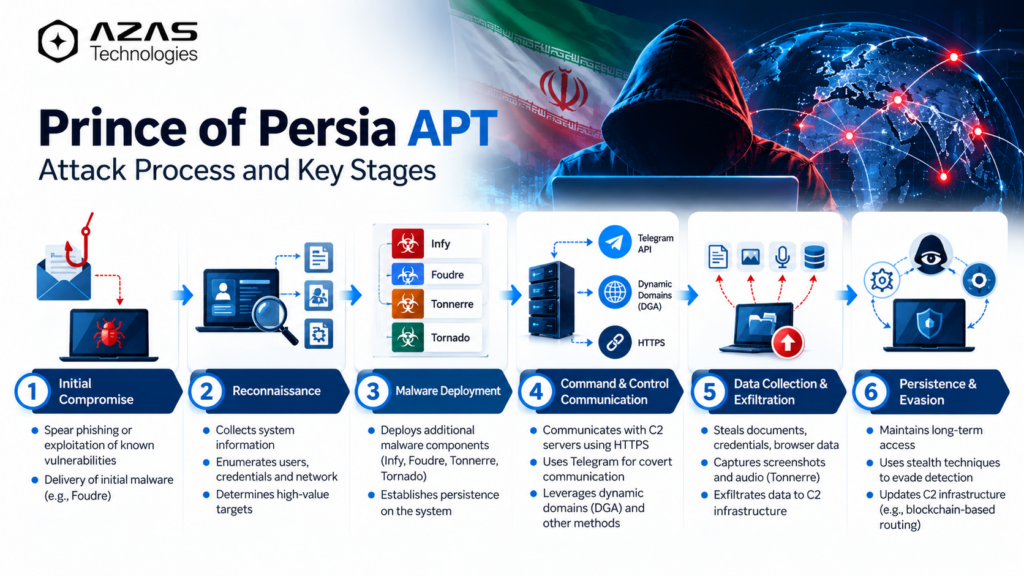
Stage 1: Initial Compromise
Attackers exploit vulnerable software or use other targeted intrusion techniques to gain access to a victim’s device.
Research has identified exploitation of known software vulnerabilities, including WinRAR-related vulnerabilities, in the group’s malware delivery ecosystem.
Stage 2: System Reconnaissance
Initial-stage malware gathers information about the compromised device, including its configuration, user environment, and potential intelligence value.
Stage 3: Malware Deployment
High-value systems may receive additional malware components such as Tonnerre or Tornado, enabling more extensive surveillance and information collection.
Stage 4: Command-and-Control Communication
The infected endpoint communicates with attacker-controlled infrastructure using HTTPS, dynamically generated domains, or Telegram-based communication channels.
Stage 5: Data Collection and Exfiltration
The attackers collect selected documents, credentials, and other sensitive information and transfer it through their command infrastructure.
Stage 6: Persistence and Evasion
The malware and its operators attempt to preserve access while reducing the effectiveness of conventional security monitoring.
This is a simplified illustration of the attack lifecycle, not a claim that every Prince of Persia intrusion follows exactly the same sequence.
Why Traditional Cybersecurity Defenses May Struggle
The Prince of Persia campaign highlights several limitations of security strategies that rely primarily on perimeter protection and known malicious IP addresses.
Legitimate Infrastructure Can Host Malicious Activity
Attackers may use reputable hosting providers and shared infrastructure to make their operations less conspicuous.
Blocking entire hosting networks is often impractical because it can interrupt legitimate business services.
Encrypted Traffic Reduces Network Visibility
HTTPS communications can conceal malicious instructions and data transfers from security tools that lack appropriate inspection or endpoint telemetry.
Telegram Can Be Used as a Covert Communication Channel
Malware that communicates through legitimate messaging APIs can blend into permitted application traffic.
This creates additional challenges for organizations that allow unrestricted access to such services.
Dynamic Domains Reduce the Effectiveness of Static Blocklists
Domain Generation Algorithms enable malware to generate and attempt connections to changing domain names.
Consequently, blocking a previously identified domain may not prevent subsequent communication.
Advanced Malware Can Evade Endpoint Detection
Sophisticated threat actors continuously modify malware execution techniques and infrastructure to reduce the effectiveness of signature-based security products.
Organizations therefore require behavioral detection, threat hunting, and coordinated security monitoring.
What Does This Mean for Businesses in the UAE?
The UAE’s position as a major international business, financial, logistics, and technology hub makes cyber resilience an important organizational priority.
Although the Semperis findings do not establish a new campaign specifically targeting UAE businesses, the techniques documented in the research are relevant to organizations throughout the Middle East.
Potential business risks include:
- Unauthorized access to sensitive corporate information
- Theft of confidential documents and intellectual property
- Compromise of privileged user accounts
- Long-term undetected access to internal systems
- Exposure of sensitive operational information
- Regulatory, contractual, and reputational consequences
Organizations should therefore evaluate whether their existing security controls can identify suspicious outbound communication, abnormal endpoint activity, and unauthorized data transfers.
How Can Organizations Defend Against Advanced Cyber Espionage?
A layered cybersecurity strategy provides stronger protection against sophisticated APT activity.
1. Deploy Next-Generation Firewalls
Next-Generation Firewalls (NGFWs) can help organizations enforce application-aware security policies, inspect permitted traffic where appropriate, and detect known malicious communication patterns.
Security teams should review outbound access policies and investigate unusual communication with external services.
2. Implement Endpoint Detection and Response
Endpoint Detection and Response (EDR) and Extended Detection and Response (XDR) solutions provide visibility into suspicious endpoint behavior.
Relevant detection opportunities include:
- Unusual process execution
- Unauthorized persistence mechanisms
- Suspicious credential access
- Unexpected file collection activity
- Abnormal outbound connections
- Potential data exfiltration
3. Conduct Regular Vulnerability Assessments and Penetration Testing
Vulnerability Assessment and Penetration Testing (VAPT) helps identify exploitable weaknesses before attackers can take advantage of them.
Priority areas should include exposed services, endpoint software, identity systems, and security configuration weaknesses.
4. Monitor Network Traffic Continuously
Network monitoring and security analytics should identify abnormal outbound traffic patterns, unexpected destinations, and changes in communication behavior.
Special attention should be given to unusual Telegram API traffic and repeated connections to suspicious dynamically generated domains.
5. Strengthen Identity Security
Organizations should implement multifactor authentication, least-privilege access, privileged account monitoring, and regular identity security assessments.
Compromised credentials can allow attackers to expand their access beyond the initially infected device.
6. Maintain Effective Patch Management
Operating systems, browsers, archive utilities, and other business applications should be updated according to a risk-based patch management program.
Known exploitable vulnerabilities should receive priority.
7. Establish Incident Response Readiness
Organizations should maintain documented incident response procedures covering endpoint isolation, evidence preservation, credential containment, threat hunting, and recovery.
Regular testing helps ensure these processes work when a real incident occurs.
Indicators of Compromise: What Should Security Teams Monitor?
Semperis published infrastructure indicators associated with Prince of Persia’s malware operations.
Examples reported in its October 2026 research include:
| Indicator | Reported association |
|---|---|
| 68.65.122.203 | Tornado second-stage C2 infrastructure |
| 185.244.129.70 | Earlier Foudre, Tonnerre, and Tornado infrastructure |
| 185.244.129.123 | Later Foudre, Tonnerre, and Tornado infrastructure |
| aa58862c.ddns.net | Tonnerre-related communication |
| kxzsfydnivzmv.privatedns.org | Tornado second-stage C2 domain |
Important: These are historical research indicators, not independently verified live malicious destinations. Shared hosting addresses may also serve legitimate websites. Security teams should enrich these indicators with current threat intelligence, DNS history, endpoint telemetry, and network context before taking blocking action.
For the complete technical indicator list, consult the original Semperis research.
How AZAS Technologies Helps Organizations Strengthen Cyber Resilience
At AZAS Technologies, we help businesses strengthen their cybersecurity posture through security technologies, assessment services, and practical risk reduction strategies.
Our cybersecurity portfolio includes:
Next-Generation Firewall Solutions
Strengthening network perimeter security through advanced threat prevention, application visibility, and controlled network access.
Endpoint Security and XDR/MDR
Helping organizations detect suspicious endpoint behavior, investigate threats, and improve response capabilities.
Vulnerability Assessment and Penetration Testing
Identifying security weaknesses across networks, servers, applications, and exposed infrastructure.
Web Application and API Security
Protecting business-critical applications against exploitation and unauthorized access.
Security Monitoring and Visibility
Improving operational awareness through network monitoring, alerting, and security infrastructure visibility.
By combining preventive security controls with proactive assessment and monitoring, organizations can improve their ability to detect and respond to sophisticated cyber threats.
Conclusion: Cyber Espionage Is Becoming Harder to Detect
The evolution of Prince of Persia demonstrates how long-running cyber espionage groups can adapt their tools and infrastructure to remain operational despite increased scrutiny.
Its use of shared hosting, Telegram-based communications, dynamic domains, and multi-stage malware reinforces a critical lesson:
Trustworthy-looking infrastructure does not automatically mean trustworthy activity.
Organizations must move beyond traditional perimeter-only security and adopt continuous visibility, behavioral threat detection, identity protection, and proactive vulnerability management.
For UAE businesses, investing in layered cybersecurity defenses is an important step toward protecting sensitive information and maintaining business resilience.
Strengthen Your Cybersecurity Posture with AZAS Technologies
Is your organization prepared to detect advanced persistent threats and hidden cyber espionage activity?
AZAS Technologies can help you assess your existing security controls, identify vulnerabilities, and strengthen protection across your network, endpoints, and critical applications.
Explore our cybersecurity solutions or contact our team for a security consultation.
Visit: AZAS Technologies CyberSecurity Services
AZAS Technologies — Innovating for a Secure Digital Future.
Frequently Asked Questions
What is the Prince of Persia APT group?
Prince of Persia is a long-running Iranian state-linked cyber espionage group known for targeted surveillance operations and malware families including Infy, Foudre, Tonnerre, and Tornado.
What makes Tornado malware dangerous?
Tornado uses multiple communication techniques, including HTTPS, Telegram APIs, and dynamically generated domains, making its command infrastructure more resilient and difficult to track.
Can next-generation firewalls detect Prince of Persia attacks?
Next-generation firewalls can detect or block some associated malicious communications, particularly when supported by updated threat intelligence and appropriate inspection policies. However, endpoint visibility and behavioral monitoring are also important.
Why do attackers use Telegram for malware communication?
Telegram provides widely used communication infrastructure and APIs. Attackers can misuse these services to exchange commands or transfer information while attempting to blend into legitimate traffic.
How can UAE businesses protect themselves from APT attacks?
Organizations should combine NGFW, EDR/XDR, vulnerability assessments, identity security, patch management, continuous monitoring, and incident response readiness.
What are indicators of compromise?
Indicators of compromise are technical artifacts, such as suspicious IP addresses, domains, file hashes, or behavioral patterns, that may help identify malicious activity. They should be assessed in context rather than treated as definitive proof of compromise.
Research Credits and References
This article is an independent educational analysis prepared for AZAS Technologies, informed by publicly available cybersecurity research.
Primary source: Semperis Security Research, Tomer Bar, Prince of Persia: Threat Group Hiding in Plain Sight, October 22, 2026.
https://www.semperis.com/blog/prince-of-persia-threat-group-hiding-in-plain-sight
Additional reporting: SecurityWeek, Iran’s Prince of Persia APT Hosts C&C in US for First Time Since 2016, October 23, 2026.
AZAS Technologies did not conduct the original threat investigation. Technical findings and infrastructure discoveries are credited to the original researchers.