How AI-assisted vulnerability research exposed serious security weaknesses in PHP—and what businesses must do to protect their web infrastructure.
Introduction: A Major Security Threat to PHP-Powered Websites
A newly disclosed set of critical vulnerabilities, collectively known as PHP2Shell, has raised serious concerns across the global cybersecurity community.
On October 21, 2026, cybersecurity researchers at Wiz publicly disclosed multiple vulnerabilities affecting the core PHP engine, including weaknesses that could enable unauthenticated Remote Code Execution (RCE) and sensitive memory disclosure.
PHP powers a significant proportion of websites worldwide, including applications built on WordPress, Drupal, Joomla, and numerous custom-developed business platforms.
According to Wiz Research, the vulnerabilities affect PHP releases dating back to version 5.4, with potentially serious consequences for organizations operating unpatched PHP environments.
Unlike conventional website vulnerabilities that originate from insecure plugins, themes, or application code, PHP2Shell targets weaknesses within the underlying PHP execution engine.
This distinction makes PHP2Shell particularly significant: even websites with securely developed application code may be exposed if they rely on a vulnerable PHP runtime.
For businesses in the UAE and worldwide, the discovery reinforces the importance of proactive vulnerability management, timely patching, and layered cybersecurity defenses.
What Is PHP2Shell?
PHP2Shell is the name given to a collection of memory-safety vulnerabilities identified in the PHP programming language’s core engine.
The vulnerabilities arise from weaknesses in how PHP manages internal memory and application state, particularly when fatal errors or memory allocation failures occur.
Under certain conditions, attackers may manipulate these weaknesses to access sensitive server memory or execute unauthorized code.
The disclosed issues are associated with two Common Vulnerabilities and Exposures (CVE) identifiers:
- CVE-2026-109618: Covers vulnerabilities involving upload-progress handling, memory corruption, and remote process-memory disclosure.
- CVE-2026-109619: Covers vulnerabilities involving fatal-error backtrace handling and OPcache state corruption that can lead to remote code execution.
The vulnerabilities reach a reported maximum severity score of CVSS 9.2, placing them in the critical category.
Successful exploitation may allow attackers to compromise affected servers without possessing valid user credentials.
Why Is PHP2Shell So Dangerous?
The primary concern is that the vulnerabilities exist in PHP itself rather than in a specific website plugin or content management system.
This creates several serious security risks.
1. Unauthenticated Remote Code Execution
Under vulnerable conditions, an attacker may execute unauthorized code on a web server without first logging in.
Depending on server permissions and security controls, successful exploitation could enable attackers to install malicious software, modify website files, access application data, or establish persistent unauthorized access.
2. Sensitive Information Disclosure
PHP2Shell can also expose information stored in PHP worker-process memory.
This may include:
- Application credentials and passwords
- Authentication tokens and session information
- API keys and integration secrets
- Sensitive information processed by web applications
- Other confidential data present in process memory
Such information could enable additional attacks against connected applications or infrastructure.
3. Impact Beyond WordPress
Although WordPress is one of the most recognizable affected platforms, PHP2Shell is not limited to WordPress.
Wiz researchers demonstrated exploitation against WordPress, Drupal, and Joomla deployments.
Other PHP-based applications may also be exposed depending on the PHP version, runtime configuration, and exploitation prerequisites.
4. Increased Risk to Internet-Facing Servers
Publicly accessible PHP applications provide potential entry points for remote attackers.
Businesses running outdated or vulnerable PHP versions may face increased exposure, particularly where critical web applications are accessible from the internet.
How Does a PHP2Shell Attack Work?
PHP2Shell exploits weaknesses in how PHP handles memory and internal processing states when requests encounter fatal errors.
In a properly functioning environment, PHP should release memory and reset relevant internal state when a request terminates.
However, the disclosed vulnerabilities can cause certain internal references to remain in an unsafe condition after an abnormal request termination.
When a subsequent request is processed, PHP may interact with memory that is no longer valid.
This can lead to memory corruption, information disclosure, or potentially remote code execution.
Simplified PHP2Shell Attack Sequence
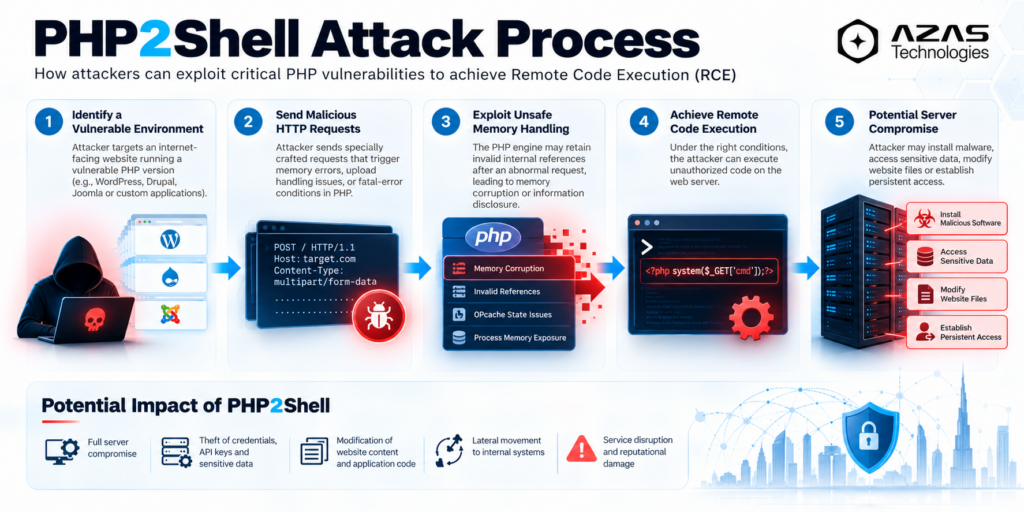
Stage 1: Identify a vulnerable PHP environment
An attacker targets a publicly accessible website or application running a vulnerable PHP runtime.
Stage 2: Trigger abnormal PHP processing
Specially constructed requests may cause memory allocation failures or other fatal-error conditions that expose vulnerable internal behavior.
Stage 3: Exploit unsafe memory handling
The PHP worker may retain invalid internal references, creating opportunities for memory disclosure or corruption during subsequent processing.
Stage 4: Achieve unauthorized access
Under suitable conditions, the attacker may exploit the resulting memory corruption to execute code or retrieve sensitive information.
Stage 5: Attempt further compromise
Following successful exploitation, an attacker could attempt to access application data, compromise connected services, or establish persistence.
These stages are a simplified illustration. Actual exploitation is technically complex and depends on the specific vulnerability, PHP configuration, and runtime conditions.
The Role of Artificial Intelligence in Discovering PHP2Shell
One of the most significant aspects of PHP2Shell is the role artificial intelligence played in its discovery and exploitation research.
According to Wiz, researchers used advanced AI systems to investigate longstanding weaknesses in PHP’s memory handling.
These tools helped researchers analyze complicated code paths, develop exploitation techniques, troubleshoot failures, and validate patches.
Some of the underlying weaknesses had existed for more than a decade.
Historically, converting such complex memory-safety issues into practical exploits required extensive specialist knowledge and significant research effort.
AI-assisted analysis can reduce some of these barriers.
What Does This Mean for Cybersecurity?
The implications extend well beyond PHP.
AI is increasingly influencing both offensive and defensive cybersecurity capabilities.
For attackers, advanced models may reduce the effort required to investigate and adapt sophisticated exploitation techniques.
For defenders, similar capabilities can accelerate code auditing, vulnerability discovery, security testing, and patch validation.
Organizations should therefore reassess security strategies that rely primarily on the assumption that complex vulnerabilities are too difficult to exploit.
The emergence of AI-assisted exploitation makes proactive security assessment and rapid remediation increasingly important.
Which Websites and Applications Are Potentially Affected?
Organizations should prioritize reviewing environments that use PHP, including:
- WordPress websites and WooCommerce stores
- Drupal and Joomla websites
- Custom PHP-based business applications
- Customer and supplier portals
- PHP-based e-commerce platforms
- Internet-facing APIs and web services
- Legacy PHP applications
- Containerized PHP workloads
The researchers reported that PHP releases dating back to version 5.4 are affected by at least one disclosed vulnerability.
However, the precise exposure of an individual deployment depends on its installed PHP build, configuration, and whether the relevant security fixes have been applied.
It is important to distinguish between the widespread use of PHP and the number of websites that are actually exploitable.
A website using PHP is not automatically confirmed to be vulnerable or exploitable.
How Can Organizations Protect Against PHP2Shell?
Organizations should treat PHP2Shell as a high-priority vulnerability management issue.
1. Update PHP Immediately
The most important remediation is to install the appropriate PHP security updates released on October 21, 2026, or later vendor-provided builds containing the fixes.
IT teams should identify the PHP versions deployed across production, staging, development, and disaster recovery environments.
For Linux-based environments, administrators can begin by checking the installed PHP CLI version:
php -v
However, the command-line PHP version may differ from the PHP runtime used by Apache, Nginx, PHP-FPM, or application containers.
Administrators must verify the actual PHP runtime serving each website.
2. Review WordPress and CMS Infrastructure
Organizations using WordPress, Drupal, or Joomla should review their complete hosting stack.
Updating a CMS or its plugins does not automatically resolve a vulnerability within the PHP engine.
Security teams should verify:
- The active PHP runtime and security patch level
- Web server and PHP-FPM configurations
- Hosting provider patch status
- Application and server access controls
- Existing security monitoring and logging
3. Deploy Web Application Firewall Protection
A Web Application Firewall (WAF) can provide an additional security layer by inspecting and filtering suspicious HTTP traffic.
Depending on the provider and available signatures, WAF protections may help mitigate known PHP2Shell exploitation patterns.
However, WAF rules are compensating controls rather than a substitute for applying the PHP security update.
4. Conduct Vulnerability Assessment and Penetration Testing
Regular Vulnerability Assessment and Penetration Testing (VAPT) can help organizations identify exposed applications, outdated software, weak configurations, and other exploitable security weaknesses.
For PHP2Shell, assessments should specifically verify runtime patch levels and review potentially affected web infrastructure.
Any active exploitation testing should be carefully authorized and controlled to avoid disrupting production services.
5. Monitor for Suspicious Activity
Security teams should investigate potentially relevant indicators, including:
- Unusual multipart HTTP requests
- Repeated PHP memory-limit or fatal errors
- Unexpected HTTP 500 responses
- Abnormal PHP worker restarts
- Suspicious or malformed PHP session cookies
- Unexpected processes initiated by web server accounts
These indicators are not definitive evidence of exploitation, but combinations of suspicious events may justify further investigation.
6. Strengthen Server and Endpoint Security
Organizations should apply defense-in-depth controls, including least-privilege service accounts, restricted outbound connectivity, centralized logging, secure configuration management, and endpoint or server workload protection.
These measures may reduce the impact of a successful compromise.
7. Review Credentials and Incident Response Readiness
If compromise is suspected, organizations should investigate potential exposure of application secrets, session information, and other sensitive data.
Credential rotation and session invalidation may be necessary based on incident findings.
Businesses should also maintain tested backups and an incident response plan to support recovery.
Why PHP2Shell Matters for UAE Businesses
Businesses across the UAE increasingly rely on websites, digital commerce platforms, online portals, and cloud-hosted applications to support daily operations.
These systems frequently integrate with payment services, customer databases, CRM platforms, email infrastructure, and third-party APIs.
A compromise affecting a public-facing PHP application could therefore create risks beyond website availability.
Potential business consequences include operational disruption, exposure of confidential information, reputational damage, and additional compromise of interconnected systems.
Organizations should evaluate PHP2Shell within their broader cybersecurity risk management programs, particularly where critical applications are hosted on internet-accessible infrastructure.
How AZAS Technologies Can Help Protect Your Business
At AZAS Technologies, we help organizations strengthen cybersecurity defenses through proactive assessments, security technologies, and infrastructure protection.
Our cybersecurity solutions can support organizations responding to vulnerabilities such as PHP2Shell.
Vulnerability Assessment and Penetration Testing
Our VAPT services help identify vulnerabilities and security weaknesses across web applications, servers, networks, and internet-facing infrastructure.
Web Application Firewall Solutions
AZAS Technologies offers web application protection solutions that help organizations strengthen defenses against malicious requests and common web-based attack techniques.
Next-Generation Firewall Protection
Next-Generation Firewall solutions help enforce network security policies, control application traffic, and reduce unauthorized access.
Extended Detection and Response
XDR and MDR solutions can support threat detection, security monitoring, and incident investigation across supported environments.
Security Configuration Assessment
Security reviews can help identify weaknesses in server configurations, access permissions, and supporting infrastructure that could increase the impact of an application compromise.
Protect Your Website Before Attackers Exploit a Critical Vulnerability
PHP2Shell demonstrates how weaknesses deep within widely used software can create significant cybersecurity risks.
Organizations should not rely solely on CMS updates, perimeter protection, or traditional antivirus software.
A comprehensive security strategy requires visibility into vulnerable software, timely patching, continuous monitoring, and appropriate incident response capabilities.
Contact AZAS Technologies to discuss a vulnerability assessment, web application security review, or cybersecurity protection strategy for your organization.
Website: https://azastechnologies.com/
Innovating for a Secure Digital Future.
Frequently Asked Questions
What is PHP2Shell?
PHP2Shell refers to critical vulnerabilities in the PHP engine that can allow remote code execution or disclosure of sensitive process memory under certain conditions.
Does PHP2Shell affect WordPress websites?
Yes. Researchers demonstrated unauthenticated remote code execution against WordPress environments using vulnerable PHP runtimes. Exposure depends on the PHP version and deployment configuration.
Can PHP2Shell be exploited without authentication?
Yes. Wiz researchers demonstrated exploitation without requiring valid application login credentials.
Is updating WordPress enough to fix PHP2Shell?
No. Because the vulnerabilities exist within the PHP engine, organizations must ensure the underlying PHP runtime receives the relevant security fixes.
Can a Web Application Firewall stop PHP2Shell attacks?
A WAF with suitable protections may help reduce exposure to known exploitation techniques. However, it cannot guarantee protection against every attack variation, and PHP patching remains essential.
Which CVEs are associated with PHP2Shell?
The disclosed vulnerabilities are tracked under CVE-2026-109618 and CVE-2026-109619.
How can businesses determine whether they are exposed?
Organizations should inventory their PHP deployments, verify installed runtime versions and vendor security fixes, review web server configurations, and conduct appropriate vulnerability assessments.
References and Research Credits
This article is an independent cybersecurity awareness and mitigation guide prepared by AZAS Technologies, based on publicly disclosed research.
Primary research: Wiz Research — PHP2Shell: AI Uncovers Critical RCE Vulnerabilities Affecting 70% of the Internet, published October 21, 2026.
https://www.wiz.io/blog/php2shell-php-rce
Official PHP security updates:
The original vulnerability research and technical discoveries are credited to Wiz Research and the other contributors acknowledged in its disclosure.