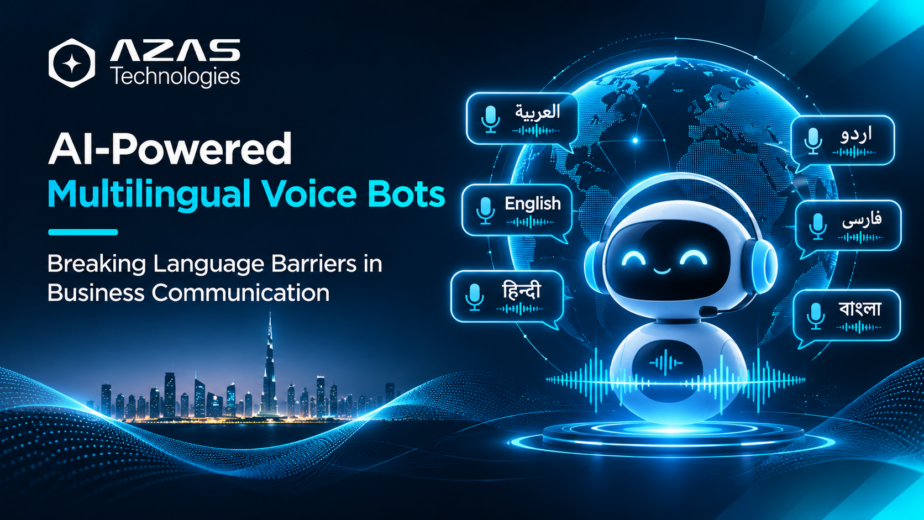
How AI-powered communication, omnichannel engagement, and intelligent automation are transforming business operations.
Introduction
In today’s rapidly evolving digital landscape, effective communication is essential for business success. Organizations are increasingly challenged by fragmented communication systems, rising customer expectations, distributed workforces, and the need to deliver faster, more personalized customer experiences.
Traditional telephone systems and disconnected communication applications are no longer sufficient to support the demands of modern enterprises.
This is where Unified Communications (UC) platforms are transforming the way businesses connect, collaborate, and engage with customers.
By integrating voice, video, messaging, contact center capabilities, and AI-powered automation into a centralized communication environment, organizations can streamline operations, improve productivity, reduce costs, and enhance customer satisfaction.
At AZAS Technologies, we help organizations across the UAE modernize their communication infrastructure with intelligent, scalable, and secure Unified Communications solutions.
What Is a Unified Communications Platform?
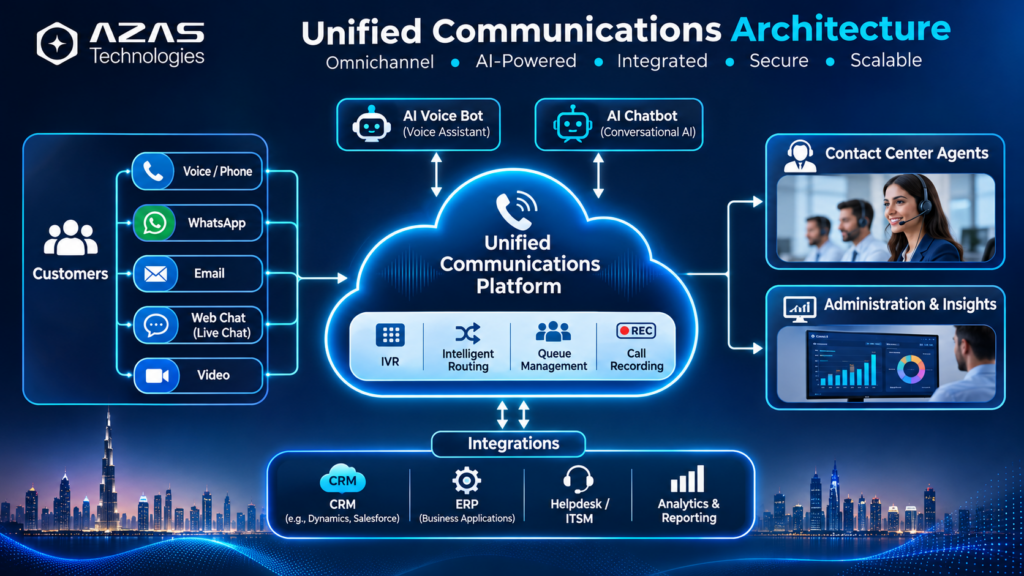
A Unified Communications platform is an integrated technology solution that combines multiple business communication channels and collaboration tools into a single environment.
Rather than managing separate systems for telephone calls, video conferencing, instant messaging, customer support, and business applications, organizations can manage these capabilities through a unified architecture.
Modern Unified Communications platforms can include:
- Enterprise IP telephony and PBX
- Voice and video communications
- Omnichannel contact center solutions
- WhatsApp, SMS, email, and web chat integration
- AI-powered voice bots and chatbots
- Intelligent Interactive Voice Response (IVR)
- Call recording and monitoring
- CRM and ERP integration
- Real-time analytics and reporting
- Cloud, on-premises, and hybrid deployment options
These capabilities enable organizations to create a connected communication ecosystem that improves both internal collaboration and external customer engagement.
1. Centralized Communication Across Multiple Channels
One of the biggest challenges businesses face is managing communications across disconnected platforms.
Employees may use different applications for telephone calls, email, messaging, and customer support, resulting in fragmented information and inefficient workflows.
A Unified Communications platform brings these communication channels together.
Key business benefits:
- Centralized management of communication channels
- Reduced dependency on multiple standalone applications
- Improved coordination between departments
- More consistent customer interactions
- Simplified administration and operational management
For example, a customer can initiate an inquiry through WhatsApp and continue the conversation through a voice call without unnecessarily repeating information, provided the platform supports shared customer interaction history.
This creates a more seamless customer experience.
2. Enhanced Customer Experience Through Omnichannel Engagement
Customer expectations have changed significantly.
Today’s customers expect organizations to respond quickly and provide consistent service regardless of whether they communicate through telephone, email, WhatsApp, or web chat.
An omnichannel contact center enables businesses to manage customer interactions across multiple channels from a centralized agent interface.
Key capabilities include:
- Intelligent call and interaction routing
- Unified customer interaction history
- Automated call distribution
- Queue management
- Customer interaction tracking
- Integration with CRM applications
By providing agents with relevant customer information, businesses can reduce response times, improve first-contact resolution, and deliver more personalized customer service.
For organizations operating in industries such as hospitality, healthcare, financial services, and retail, this can significantly improve the customer experience.
3. AI-Powered Voice Bots and Chatbots
Artificial Intelligence is becoming an increasingly important component of modern business communications.
AI-powered voice bots and chatbots can automate routine customer interactions, answer frequently asked questions, and assist customers without requiring continuous human intervention.
These intelligent assistants can support:
- Automated customer inquiries
- Appointment scheduling
- Service request registration
- Order and ticket status updates
- Intelligent call routing
- Multilingual customer engagement
- After-hours customer assistance
For example, a healthcare organization can use an AI-powered voice assistant to handle appointment inquiries, while a hospitality business can automate frequently asked questions about reservations, facilities, and services.
Business impact: AI automation allows employees to focus on complex customer requirements while routine interactions are handled efficiently.
Human escalation remains essential for sensitive, complex, or unresolved requests.
4. Reduced Communication and Operational Costs
Maintaining multiple independent communication systems can increase infrastructure, licensing, maintenance, and administration costs.
Unified Communications platforms help organizations consolidate these systems into a more manageable architecture.
Potential cost benefits include:
- Reduced dependency on traditional telephony infrastructure
- Consolidation of communication applications
- Lower administration and maintenance overhead
- Reduced manual workload through automation
- Improved resource utilization
- More efficient contact center operations
Cloud-based and hybrid deployment models can also provide flexibility in infrastructure investment.
Actual cost savings depend on existing systems, call volumes, licensing, integration requirements, and deployment architecture.
5. Improved Employee Productivity and Collaboration
Efficient communication is not limited to customer interactions.
Internal collaboration plays an equally important role in business performance.
Unified Communications platforms help employees communicate and collaborate more effectively, whether they are working from corporate offices, branch locations, or remote environments.
Key advantages include:
- Faster communication between departments
- Simplified call transfer and conferencing
- Improved availability and responsiveness
- Remote access to business communication tools
- Reduced switching between applications
- Better collaboration across distributed teams
For organizations with multiple branches across the UAE, centralized communications can simplify coordination and improve operational efficiency.
6. Real-Time Analytics and Performance Monitoring
Organizations need visibility into their communication operations to make informed business decisions.
Modern Unified Communications and contact center platforms provide reporting and analytics capabilities that help businesses monitor communication performance.
Common metrics include:
| Performance Metric | Business Value |
|---|---|
| Call volume | Understand communication demand |
| Average handling time | Evaluate operational efficiency |
| Call abandonment rate | Identify customer service bottlenecks |
| First-contact resolution | Measure service effectiveness |
| Agent performance | Optimize workforce productivity |
| Queue waiting time | Improve response times |
| Customer interaction trends | Support data-driven decisions |
These insights enable management teams to identify inefficiencies, improve resource allocation, and continuously optimize customer service operations.
7. Seamless Integration With CRM and Enterprise Applications
Communication systems become significantly more valuable when integrated with existing business applications.
Modern Unified Communications platforms can support integration with CRM, ERP, helpdesk, and other enterprise systems through supported APIs and connectors.
Integration possibilities include:
- Microsoft Dynamics 365
- Salesforce
- Customer service and helpdesk platforms
- Enterprise resource planning applications
- Custom business applications
- Workflow automation systems
For example, an incoming customer call can trigger a CRM screen pop displaying relevant customer information.
Similarly, completed calls can be logged automatically, reducing manual data entry and improving record accuracy.
Integration availability depends on the specific platform, API support, and application configuration.
8. Flexible Cloud, On-Premises, and Hybrid Deployment
Every organization has different infrastructure, security, and regulatory requirements.
A flexible Unified Communications architecture allows businesses to select a deployment model that aligns with their operational needs.
Cloud deployment
Suitable for organizations seeking centralized management, scalable services, and reduced dependence on locally hosted communication infrastructure.
On-premises deployment
Suitable for organizations requiring greater control over their communication infrastructure, local integration, or specific data handling requirements.
Hybrid deployment
Combines cloud services with on-premises communication infrastructure, providing flexibility for organizations with complex or distributed environments.
For UAE organizations, deployment decisions should also consider data residency, regulatory requirements, telecommunications connectivity, and business continuity.
9. Enterprise Security and Business Continuity
Business communications frequently involve confidential customer information, internal discussions, and operationally sensitive data.
Protecting these communications is essential.
Depending on the selected solution, enterprise security capabilities may include:
- Encrypted communications
- Role-based access controls
- Multi-factor authentication
- Call recording access restrictions
- Audit logs
- Secure API integrations
- Network segmentation
- Redundant infrastructure
- Backup and disaster recovery options
A properly designed communication environment can also support business continuity through redundant servers, network paths, and failover mechanisms.
Security and availability must be validated against the selected platform and deployment design.
10. Scalability and Future-Ready Communication Infrastructure
As organizations grow, their communication requirements evolve.
Traditional systems can become difficult and expensive to expand, particularly when businesses establish additional offices or increase contact center capacity.
Modern Unified Communications platforms provide scalable architectures that can accommodate changing requirements.
Organizations can potentially:
- Add users and communication endpoints
- Expand contact center capacity
- Introduce additional communication channels
- Deploy AI-powered automation
- Integrate new business applications
- Support additional branches and remote teams
This enables businesses to develop a communication strategy that supports long-term digital transformation.
The Role of AI in the Future of Unified Communications
Unified Communications is evolving beyond traditional voice and messaging capabilities.
The next generation of enterprise communication platforms increasingly incorporates Artificial Intelligence, conversational automation, and advanced analytics.
Important developments include:
Conversational AI: Natural-language interactions that allow customers to communicate with automated assistants more intuitively.
Intelligent Call Routing: Routing interactions based on customer requirements, agent skills, and operational priorities.
AI-Assisted Customer Support: Helping agents access relevant information and respond more efficiently.
Automated Workflows: Connecting communication events with business processes to reduce repetitive administrative tasks.
Advanced Interaction Analytics: Analyzing communication trends to identify service improvements and operational opportunities.
Organizations adopting these capabilities can improve responsiveness while maintaining human oversight for critical interactions.
Why Unified Communications Matters for Businesses in the UAE
The UAE continues to advance its digital transformation initiatives across government, hospitality, healthcare, construction, financial services, and other industries.
As organizations expand their digital services, reliable and integrated communications become increasingly important.
Unified Communications solutions can help UAE businesses:
- Improve customer engagement across digital channels
- Support multilingual customer service
- Connect geographically distributed operations
- Modernize legacy telephone infrastructure
- Introduce AI-powered customer service automation
- Improve service visibility and operational efficiency
- Support secure and scalable communication architectures
Organizations should ensure that their selected communication technologies and connectivity arrangements comply with applicable UAE telecommunications and data protection requirements.
How AZAS Technologies Can Help
At AZAS Technologies, we help businesses modernize their communication infrastructure through intelligent Unified Communications and customer engagement solutions.
Our approach focuses on understanding business requirements, evaluating existing communication environments, and delivering solutions that improve operational efficiency and customer experience.
Our Unified Communications offerings include:
- Enterprise IP telephony and PBX solutions
- Omnichannel contact center platforms
- AI-powered voice bots and chatbots
- Intelligent IVR and call routing
- CRM and enterprise application integration
- Cloud and on-premises communication deployment
- Communication infrastructure integration
- Technical support and ongoing optimization
By combining Unified Communications with our expertise in cybersecurity, networking, and AI solutions, AZAS Technologies helps organizations build connected, secure, and future-ready business environments.
Conclusion
Unified Communications platforms are becoming an essential component of modern enterprise infrastructure.
By consolidating voice, messaging, customer engagement, and intelligent automation into an integrated environment, organizations can improve productivity, optimize operational costs, and deliver better customer experiences.
For businesses looking to modernize legacy communication systems or introduce AI-powered customer engagement, Unified Communications provides a flexible foundation for digital transformation.
Ready to Transform Your Business Communications?
Discover how AZAS Technologies can help your organization implement intelligent, secure, and scalable Unified Communications solutions.
Contact AZAS Technologies to discuss your communication requirements and explore a solution tailored to your business.
Website: https://azastechnologies.com